Estimating the Cost of Excavation on the Moon: A Protocol-Based Approach
A collaborative, peer reviewed paper examining how construction cost methodology holds up when familiar assumptions disappear. My contribution focused on excavation, translating terrestrial cost logic to lunar conditions where gravity, equipment, production, and material behavior all change. The point was never the Moon. It was whether the method still holds when everything familiar falls away.
The full version is available in the pdf attached. Below is my contribution to the collaborative paper.
Estimating the Cost of Excavation on the Moon: A Protocol-Based Approach
Author: Rifka Malik, CPE, CPESC
Date: September 2026
Executive Summary
This paper explores key considerations in developing a structured methodology for estimating excavation costs on the lunar surface. While grounded in proven Earth-based estimating principles, the paper highlights unique technical and cost-related challenges under lunar conditions. As lunar infrastructure development becomes increasingly viable, the need for estimating practices that are disciplined, repeatable, and above all transparent is critical.
This document identifies key parallels between terrestrial and lunar excavation while highlighting fundamental differences that affect cost. These differences include variable regolith behavior, terrain unpredictability, limited equipment availability, differential gravity, and spoil management in a uniquely challenging vacuum and low-gravity environment.
Core cost drivers include excavation depth, production rates, material expansion and compression, terrain variability, safety and stability, utility bedding requirements, and the viability of in situ resource utilization (ISRU). Each domain is analyzed through a cost-estimating lens, focusing on assumptions, contingencies, and how known data integrates with reasonable projections.
This paper is intended for use by estimators, engineers, and mission planners seeking to build defensible cost models for lunar surface operations. It serves as a foundational guide that can be adapted and refined as mission data, technology, and field experience evolve. This document does not attempt to produce a complete model. Rather, it proposes a structured way to think about estimating in a domain where so much remains uncertain.
Keywords:
Lunar Excavation Cost Estimating, Lunar Excavation, Projecting Lunar Excavation Costs
Table of Contents
- Defining Scope
- Excavation Depth and Production Rates
- Excavation Safety and Slope Stability
- Material Expansion and Compression
- Spoils Management
- Terrain Variability
- Utility Bedding and Foundation Support
- Material Sourcing and In Situ Resource Utilization (ISRU) Integration
- Closing Summary
1. Defining Scope
A reliable estimate begins with a clearly defined scope of work. On the Moon, where many environmental and technical variables remain uncertain, the starting point is to draw parallels to Earth-based excavation practices and identify key differences. These differences drive the adjustments needed to account for lunar conditions across geotechnical, logistical, and operational domains.
Lunar gravity is approximately one-sixth that of Earth. This fundamental difference underpins nearly every deviation from terrestrial excavation norms. It affects equipment behavior, soil mechanics, spoil trajectories, slope stability, hauling logistics, and energy consumption. Throughout this document, differential gravity should be understood as a universal modifier that shapes both the physical mechanics and cost implications of lunar excavation.
When Apollo 16 Lunar Module Pilot Charles M. Duke, Jr. was asked by Paul Thies in an interview how it felt to have less gravity on the moon he responded:
“Well, it was a good deal. Let me put it that way. When I put on my spacesuit, backpack, life support system, and all the equipment, down here on Earth, I weighed . . . I think it was 363 pounds. Well, up there that turns into 60 pounds. And so you had this lightness as you ran across the Moon or you hopped across the Moon. But the suit is stiff and you couldn't bend at the waist. . . .It took a lot of work to move the spacesuit . . . In the undulating, lunar surface, you fell down a lot. You tripped over a rock or you stumbled . . . It was three pushups to get up. And so you were always working” (Jacobs, 2022, p. 4).
His account reinforces the central principle that estimating must follow the logic of the environment. Reduced gravity introduces both efficiencies and complications, not inherently good or bad, but materially different. While weight is reduced, effort might not be. Tasks that seem easier may be offset by other constraints. A defensible estimate must reflect these tradeoffs, quantifying conditions as they are, not as we assume or hope them to be.
Excavation is not a standalone task. It inherently generates spoils, and cost implications are incomplete without a full lifecycle analysis of how those spoils are handled. Hauling, processing, storing, stabilizing, and resolving the final disposition of material are all essential contributors to total cost that must be incorporated into the estimating protocol from the outset.
These variables, especially those with no Earth-based precedent, underscore why estimating on the Moon demands a careful and deliberate protocol. “Allocating cost to units involves a complex process. When an estimator ‘puts a number’ on a unit, identifying it as cost, there must be a logic behind it that the estimator understands fully, one involving a comprehensive methodology, formulated specifically to the entity that will rely on it” (Malik, 2019, p. 25).
2. Excavation Depth and Production Rates
Lunar regolith characteristics change with depth, and excavation production rates will likely decrease as denser layers are encountered. Heiken, Vaniman, and French (1991) observed that the in situ relative density of lunar soil, a measure of compaction state ranging from loosest to densest possible condition, increases significantly with depth, from approximately 65% near the surface to over 90% beyond 30 cm, suggesting higher resistance and reduced excavation efficiency as depth increases (p. 495).
Just as major Earth-based excavation projects rely on project-specific geotechnical studies to inform production assumptions and guide equipment selection, lunar projects will require a comparable understanding of subsurface variability to produce reliable cost estimates.
Cost implications arise from changes in:
- Equipment type and capability required to excavate denser material
- Production efficiency across variable strata
- Energy demands as excavation difficulty increases
- Equipment maintenance and downtime as mechanical stress increases with material density
- In situ resource utilization (ISRU) potential based on material type
Reliable estimates must account for how variable subsurface conditions affect productivity and cost across the excavation scope. Ongoing trials with NASA’s RASSOR (Regolith Advanced Surface Systems Operations Robot), a lightweight lunar excavator prototype, are expected to provide data on excavation performance in low-gravity, regolith environments. As testing advances, estimators will be better equipped to align production rates and cost assumptions with equipment capabilities suited to lunar site conditions (NASA, n.d.-b).
3. Excavation Safety and Slope Stability
On Earth, excavation safety and slope stability are not just engineering concerns; they are direct cost drivers that influence equipment selection, production rates, and choice of techniques such as benching or sloping. Estimators routinely account for the cost of shoring systems and protective measures based on soil conditions, excavation depth, and regulatory requirements. Failures of natural slopes, deep excavations, or unsupported trench walls can result in delays, rework, equipment damage, or even loss of life, each carrying measurable cost implications. Terrestrial estimating benefits from a robust body of geotechnical data, standardized safety protocols, and well-characterized soil behavior.
According to Mitchell, Houston, Carrier, and Costes (1974), soil mechanics was one of the few areas studied across all Apollo missions, and the resulting continuity and interaction with other parts of the program proved valuable (p. 2). However, much remains unknown. From a costing perspective, excavation safety on the Moon should be approached as a high-risk, design-critical factor, requiring conservative estimates of excavation and slope stability and appropriate risk buffers to account for unknowns in soil behavior until more precise performance data becomes available.
Lunar Regolith Properties: Shear strength, which results from a combination of soil cohesion and internal friction angle, is a key factor governing the stability of lunar regolith. As Connolly and Carrier (2023) explain, “the cohesion and the frictional shear strength of the lunar regolith allowed the astronauts to dig trenches in the lunar surface with smooth, nearly vertical walls. Because of the low lunar gravity, trenches with vertical walls can be excavated to a depth of approximately 3 m, and drill core holes will remain open and stable to that same depth” (Connolly & Carrier, 2023, p. 4).
However, they further caution that “Apollo missions probed no more than a few meters into the lunar surface, and as depth below the lunar surface increases, the understanding of geotechnical properties transition from known, measured values towards best engineering estimates and models. One geotechnical truth is that lunar surface properties change with depth, and an understanding of density, cohesion, shear strength, and porosity of the lunar regolith, as these properties increase with depth, is essential to an understanding of the lunar surface” (Connolly & Carrier, 2023, p. 7).
Commander Alan B. Shepard Jr., of the Apollo 14 crew, described the challenge of trench excavation on the moon. “You know what’s happening in this trench; It’s the surface fines are so loose that they’re just falling down covering the layering that we want to get. I’ll tell you, we’re not going to get a classic vertical wall here, Houston, In this trench” (Bailey & Ulrich, 1975a, p. 118). Addressing depth and slope conditions, he added “Well, actually, the first cut I took was down to about 6 inches and there was some caving at that time. The side walls were standing probably about 70 to 80 degrees. The next cut I took made the walls a little more steep, closer to the vertical perhaps 80, 85; and, at that point, they started coming down. Fine-grain regolith, at the top of the cut, just a couple down into the trench” (Bailey & Ulrich, 1975a, pp. 136-137).
Safety Protocols: With no equivalent to the Occupational Safety and Health Administration (OSHA) on the Moon, safety standards must be engineered based on material behavior, excavation requirements, and mission-specific risk tolerance. These engineered standards will directly influence production rates and the protective measures incorporated into the estimate.
4. Material Expansion and Compression
On Earth, project estimates account for expansion and compression factors when soil is being excavated or compacted. These volumetric changes impact haul quantities, stockpile sizing, backfill requirements, final placement volumes, and equipment cycles. The same considerations are expected to apply to the lunar regolith. According to Heiken, Vaniman, and French (1991), “the in situ lunar soil is very dense, with a greater density than could be produced with mechanical compaction equipment. The processes of handling and manipulating the lunar soil would loosen it considerably, and it would not then be possible to compact the soil back to its original, undisturbed density” (p. 521). Estimates should be guided by the best available data, with uncertainty in regolith performance addressed through carefully considered variability ranges and built-in cost contingencies.
Expansion and compression ratios should be reflected in quantity takeoffs, equipment selection, and cycle time calculations. These adjustments influence hauling demands, storage capacity, and the quantity of material available for ISRU, making them essential cost drivers in lunar excavation estimates.
5. Spoils Management
On Earth, poor spoil management leads to excessive handling, site congestion, and costly rework. The same concerns presumably apply on the Moon, though influenced by different environmental factors. Spoil handling should be evaluated as a continuous cost center, not a one-time operation. Differential gravity on the lunar surface affects the shape and dispersal pattern of spoil piles. These factors directly influence site layout, equipment access, and rehandling risk. Estimating protocols should consider the following:
Placement: The proximity of stockpiles to the excavation site, terrain, and stabilization practices required will impact cost.
Hauling: Equipment selection and productivity depend on gravity, traction, terrain, and regolith behavior. Equipment options should be evaluated for feasibility and operational efficiency under lunar conditions.
Stabilization: On Earth, spoil piles are often stabilized to prevent erosion or collapse. On the Moon, dust migration and material displacement pose unique risks. Stabilization methods, whether mechanical, chemical, or structural, should be costed based on their feasibility and application.
In Situ Resource Utilization (ISRU): Estimates should account for processing regolith into usable forms. This includes evaluating the percentage of extractable material, processing cost, and handling of residual waste.
Long-Term Impact: Earth-based estimates account for future site access and construction phasing when planning spoil placement. While lunar conditions differ, it is reasonable to assume that poor placement could result in rehandling, restricted access, or operational delays. Estimates should prioritize single-handling where possible, while also incorporating allowances for cases where optimal placement cannot be achieved due to mission constraints or site evolution.
6. Terrain Variability
Lunar terrain presents significant variability and unpredictability, with direct implications for construction planning, estimating accuracy, and operational logistics. Firsthand accounts from Apollo missions underscore the extent to which lunar topography can deviate from prior assumptions.
Surface Topography: Lunar elevations and subsurface conditions are more complex than satellite-based maps suggest. Upon landing, Commander Alan Shepard of the Apollo 14 mission remarked, “as I sweep from one horizon to the other, we find that the terrain is a little rougher than I suspected” (Bailey & Ulrich, 1975a, p. 11). Lunar Module Pilot Edgar D. Mitchell added, “Let me suffice it to say that I think there is more terrain, more relief here, than we anticipated from looking at the maps” (Bailey & Ulrich, 1975a, p. 13).
Echoing this experience on a later mission, Apollo 17 Commander Eugene A. Cernan observed, “I guess the thing that probably surprised me the most about the site, as far as landing is concerned, is the fact that there were these – I hesitate to say they’re outcrops but certainly they’re buried massive pieces of rock. …And we’re talking about anywhere from 1 to 2 meters down to – oh, 2 or 3 feet, which, when they’re sticking out and on the sides of some of these subtle craters look pretty menacing” (Bailey & Ulrich, 1975b, p. 13).
Uneven terrain will impact equipment mobility and production rates. Estimating protocols should incorporate adjustment factors for terrain difficulty.
Boulders and Obstructions: Astronauts encountered both visible and partially buried boulders of significant size. “But there certainly are boulders on it. From here, it looks as though they are at least 20 feet in diameter perhaps,” Commander Shepard observed (Bailey & Ulrich, 1975a, p. 24). Pilot Mitchell noted, “the area here is in an area of considerably more boulders, a larger boulder field, more numerous boulders than we’ve seen in the past.” (Bailey & Ulrich, 1975a, p. 84). Importantly, many were not fully visible: “There’s a lot of them buried, half buried, a few of the smaller ones sitting on the surface” (Bailey & Ulrich, 1975a, p. 84). These observations were reinforced during Apollo 17 by Lunar Module Pilot Harrison H. Schmitt, who remarked “There aren’t very many rocks that just sit on the surface. All of them seem to be slightly buried to moderately buried” (Bailey & Ulrich, 1975b, p.145). Such variability demands flexibility in estimating assumptions. Large boulders may necessitate rerouting, alternative strategies for trench and mass excavation, and allowances for potential equipment damage, each with implications for schedule and cost.
Craters and Navigational Impact: Numerous craters posed both obstacles and surprises. “I think you'll have to go around this crater, here, to the left… Good heavens, that's a deep hole,” Commander Alan B. Shepard Jr. warned (Bailey & Ulrich, 1975a, p. 38). He also noted, “It’s a very uneven landing area here. And, of course, like all of the sections of the Moon, it’s pockmarked by a - enormous amount of craters.” (Bailey & Ulrich, 1975a, p. 23). These features affect mobility, safety planning, and equipment performance that should be considered in the cost estimate.
Predictive Modeling: The Apollo missions revealed ground-level challenges that continue to inform how we approach estimating for lunar construction. “Nothing like being up to your armpits in lunar dust,” remarked Commander Shepard, highlighting surface conditions that directly affect mobility, equipment performance, and labor productivity (Bailey & Ulrich, 1975a, p. 39). These are not abstract observations; they reflect the real obstacles construction teams will face and must be reflected in any cost or schedule model. As astronaut Mitchell later reflected, “There are so many things we'd like to have done; so many things to do, so many interesting things to look at here, and we didn't even have the chance to scratch the surface” (Bailey & Ulrich, 1975a, p. 141). While lunar exploration has advanced since these missions, the underlying truth remains that much of the Moon’s terrain and behavior is still unknown. These firsthand insights reinforce the need for predictive modeling that incorporates probabilistic inputs and wide tolerances. Parametric estimating, where cost drivers adjust with excavation depth, equipment limitations, and environmental variables like gravity, provides a defensible approach when empirical data is limited. Estimating protocols must allow for uncertainty in surface conditions, subsurface variability, and terrain interactions, particularly in environments where real-time adjustments are limited and costly.
7. Utility Bedding and Foundation Support
Earth-based infrastructure relies on bedding materials to support conduits, footings, and other subsurface elements. Even in favorable soils, select bedding and backfill are used to ensure long-term performance and avoid pipe, cable, or foundation failure.
On the Moon, cost estimators need to evaluate:
- Whether appropriate bedding can be sourced or manufactured in situ
- How much effort and energy are required to screen or process native regolith
- The cost of transporting bedding materials from Earth where ISRU solutions are not viable
These elements affect the feasibility and cost of constructing utility systems and supporting structural foundations. Although their functions differ, both utilities and foundations rely on bedding and/or structural fill to achieve uniform load distribution and prevent settlement. On Earth, the risk of differential settlement is often mitigated by overblasting into rock and rebuilding the zone with compacted structural fill, particularly when subsurface conditions vary across the foundation footprint. On the Moon, these practices may require adapted methods, depending on the availability and behavior of local material.
As lunar development progresses, cost estimators will likely face a three-way decision when preparing the subsurface to support structures: (a) bore into solid layers to directly bear loads on competent material, (b) Excavate across the footprint to a uniform depth, potentially extending into denser layers or rock in some areas, and replace the zone with structural fill to equalize bearing conditions and mitigate differential settlement,or (c) modify the native regolith until a satisfactory base is achieved. Each option introduces distinct operational demands, costs, time implications, and long-term performance risks. Incorporating this decision logic into early estimating protocols will improve defensibility and may serve as a foundation for developing a Lang Factor specific to lunar surface construction.
8. Material Sourcing and In Situ Resource Utilization Integration
On Earth, estimates are shaped by the balance between sourcing materials on site and importing them from external suppliers. The same cost-based evaluation applies on the Moon, with the added complexity of extreme transport costs and limited in situ processing infrastructure.
Project estimates must assess the feasibility and cost implications of in situ resource utilization (ISRU) compared to transporting materials from Earth. This includes evaluating the technical readiness, energy requirements, and equipment needs associated with ISRU processes such as:
- Screening regolith or crushing rocks for use as structural fill or base material
- Sintering or melting for fabrication of various materials
- Extracting volatiles for life support, fuel, or industrial use
Each ISRU pathway carries distinct capital and operational costs that should be estimated based on current research, prototype performance, and Earth analogs where available. Where ISRU is not viable or proven, estimators must include transport costs for imported material, factoring in mass, packaging, and launch logistics.
Reliable estimates should reflect both the preferred ISRU approach and fallback options requiring imported material. Value analysis is recommended to compare cost exposure for different sourcing scenarios, especially in early-stage designs where mission architecture is still evolving and continues to shape logistics, infrastructure layout, and operational planning.
9. Closing Summary
Estimating the cost of excavation on the Moon requires a structured approach grounded in sound estimating principles. Drawing on Earth-based methodologies provides a practical foundation. However, it is paramount to identify and recognize the fundamental differences introduced by the lunar environment. Project estimates must carefully identify where those parallels hold and where assumptions must be adapted.
The estimating protocols outlined here emphasize the importance of defining scope, understanding regolith behavior, accounting for spoil management, evaluating terrain and excavation and slope stability, and assessing sourcing strategies for materials and bedding. In each case, cost implications must be derived not from speculative scenarios but from a disciplined analysis of what is known, what can reasonably be assumed, and where contingencies are necessary.
As lunar missions progress and data improves, estimating protocols will evolve. Until then, cost models must remain flexible and defensible, anchored in experience, adjusted for lunar conditions, and ready to inform critical decisions in mission planning and infrastructure development. Estimating lunar excavation is about structuring uncertainty in a way that supports credible decision-making.
This document is not a finalized model but a foundational framework to guide estimation in an untested domain. As mission planning advances and lunar construction concepts move from conceptual design into feasibility and procurement, this work can serve as a foundation for developing a formal estimating protocol. Future iterations should incorporate evolving mission architectures, equipment-specific performance data, and validated subsurface modeling. Collaboration between lunar scientists, civil engineers, and cost professionals will be essential to refine assumptions and establish a credible basis of estimate for lunar surface operations. As these concepts move toward development and execution, disciplined cost estimating will be central to project viability, investment decisions, and the responsible allocation of resources in an emerging and capital-intensive domain.
Glossary of Terms and Acronyms
Bench / Benching
A step-like excavation technique used to reduce slope failure risk and improve stability in deep cuts.
Cohesion
The component of soil shear strength resulting from electrostatic or chemical bonding between particles.
Compression Factor
The ratio describing the reduction in soil volume when it is compacted from a loose to a dense state.
Contingency Allowance
An added cost factor to account for uncertainty, risk, or incomplete information in early-stage estimates.
Cycle Time
The total time required for one complete operation cycle of excavation equipment (e.g., dig, load, haul, return).
Density (In Situ)
The mass per unit volume of undisturbed soil or regolith in its natural state.
ISRU (In Situ Resource Utilization)
The use of local materials (e.g., lunar regolith) for construction, life support, or fuel production, reducing dependence on Earth-supplied resources.
Lunar Regolith
The layer of loose, fragmented, and unconsolidated rock material covering solid bedrock on the Moon, created by meteoroid impacts and lacking organic content.
Shear Strength
The resistance of a material to sliding failure along a plane, governed by cohesion and internal friction.
References
Bailey, N. G., & Ulrich, G. E. (1975a). Apollo 14 voice transcript pertaining to the geology of thelanding site (USGS-GD-74-028). U.S. Geological Survey, Branch of Astrogeology.
Bailey, N. G., & Ulrich, G. E. (1975b). Apollo 17 voice transcript: Pertaining to the geology of the landing site (USGS-GD-74-031). U.S. Geological Survey, Branch of Astrogeology.
Connolly, J., & Carrier, W. D. (2023). An engineering guide to lunar geotechnical properties. 2023 IEEE Aerospace Conference, 1–9. https://ntrs.nasa.gov/api/citations/20220014634/downloads/Final%20IEEE%20paper%20formatted%20footnote%20added.pdf (opens in a new tab)
Heiken, G., Vaniman, D., & French, B. M. (1991). Lunar sourcebook: A user’s guide to the Moon. Cambridge University Press.
Jacobs. (2022, March). If/When podcast episode 48: The legacy of Apollo 16 [Transcript]. Jacobs Engineering Group. https://www.jacobs.com/sites/default/files/2022-03/IfWhen_Episode48.pdf
Malik, R. (2019). The role of an estimator: Clearing up the misconceptions. Design Cost Data, July–August, 25–26. https://dcd.com/articles/the-role-of-an-estimator-clearing-up-the-misconceptions/
Mitchell, J. K., Houston, W. N., Carrier, W. D. III, & Costes, N. C. (1974). Apollo soil mechanics experiment S-200: Final report covering work performed under NASA contract NAS9-11266 (NASA CR-134306). University of California, Berkeley. https://ntrs.nasa.gov/api/citations/19740008050/downloads/19740008050.pdf (opens in a new tab)
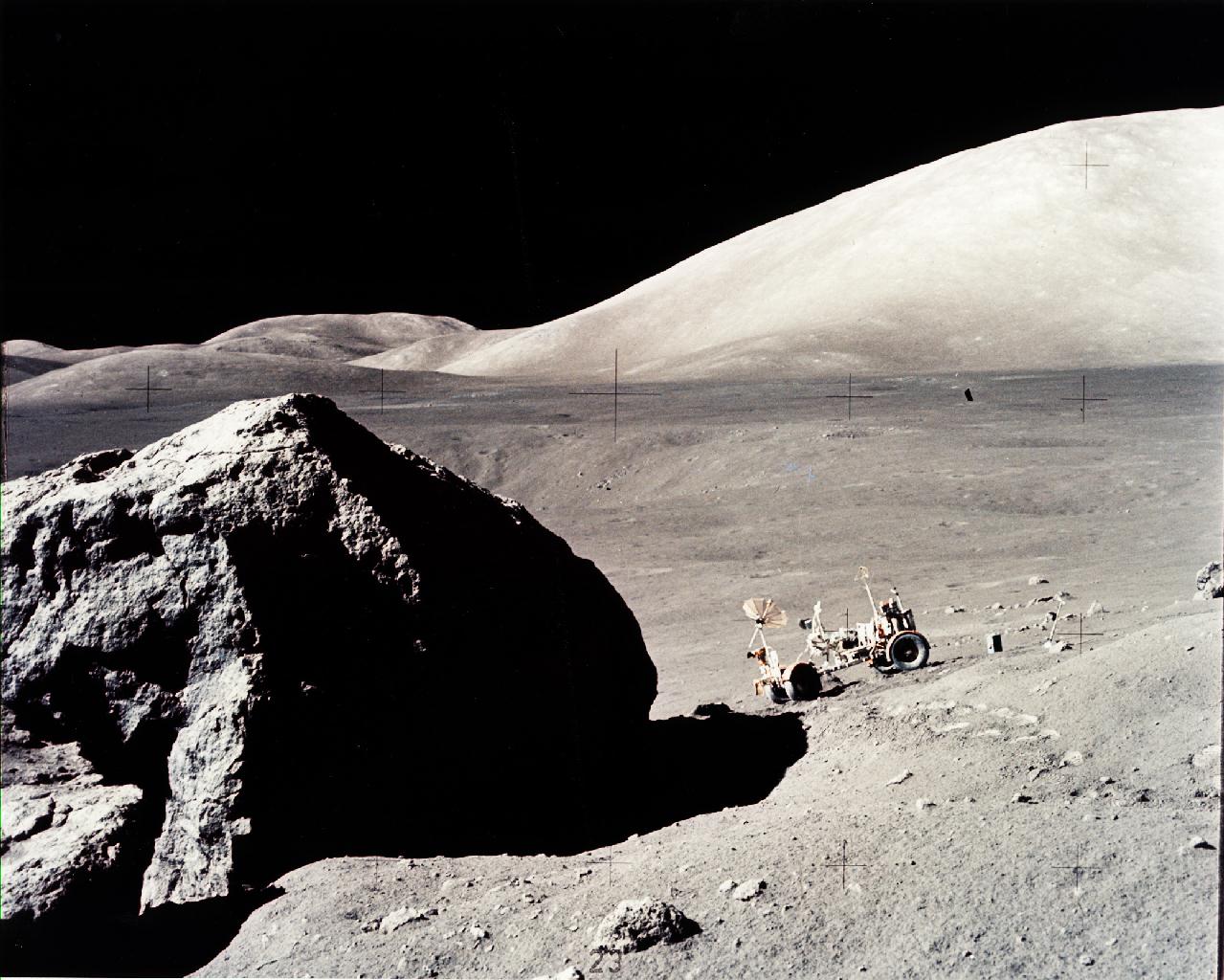
NASA. (1972, December 13). Apollo 17 image AS17-140-21494: Lunar surface view at Taurus-Littrow landing site [Photograph]. NASA. https://www.nasa.gov/wp-content/uploads/static/history/alsj/a17/21494hr.jpg (opens in a new tab)
NASA. (n.d.-a). RASSOR lunar excavator [3D image model]. NASA 3D Resources. https://nasa3d.arc.nasa.gov/detail/RASSOR (opens in a new tab)
NASA. (n.d.-b). Regolith Advanced Surface Systems Operations Robot (RASSOR) Excavator. NASA Technology Transfer Program. https://technology.nasa.gov/patent/KSC-TOPS-7 (opens in a new tab)